Reiki (pronounced Ray - key) is a the combination of two Japanese words - Rei and Ki. The meaning of the Rei is interpreted as: universal or spiritual, and holding a God-Consciousness. Ki means the same as Chi in Chinese, Prana, in Sanskrit, and Ti or Ki in Hawaiian - these words all translating to: Life force or life energy. It is the God-Consciousness called Rei that guides the life force called Ki in the practice we call Reiki. Therefore, Rei … Read More

Reiki and Energy Healing, Meditation, The Aura and Chakra's.
Showing posts with label Energy Body.. Show all posts
Showing posts with label Energy Body.. Show all posts
Saturday, 23 October 2010
~The Powerful Healing Energy Of Reiki~ (via Serenity by Karen)
A wonderful article and very informative. Jules.

Saturday, 16 October 2010

Thursday, 14 October 2010
thank you (via the dream life)
A very inspiring and uplifting post...............Thank You.
for everything.
Thank you for the answered requests, the sudden gifts, the open doors, the signs in my path, your whispered love, the shelter of your arms, the knowing in my heart, the courage to speak.
Thank you for the pain. Thank you for the closed doors, the unanswered prayers, the silences.
Thank you for the cravings. Thank you for the tears. Thank you for the long, blank days.
Thank you for the days filled with wonder.
The glitter, the pillows, the dragonflies, the way the wind moves through the trees, the jokes I’m not expecting, the shoes that pinch my feet, the music in the night. I don’t know where it’s coming from.
Thank you for the answers you have given to me. The ones I asked for, the ones I didn’t.
Thank you for this bravery that sings in me.
Thank you for stepping with me, at my side, believing.
Thank you for the fear.
Thank you for the hunger that can never be met. Thank you for meeting it.
Thank you for false starts and blind alleys. Thank you for angels that carry me home.
These questions. This trust.
The love so big it shakes in my blood.
Thank you.
via the dream life
for everything.
Thank you for the answered requests, the sudden gifts, the open doors, the signs in my path, your whispered love, the shelter of your arms, the knowing in my heart, the courage to speak.
Thank you for the pain. Thank you for the closed doors, the unanswered prayers, the silences.
Thank you for the cravings. Thank you for the tears. Thank you for the long, blank days.
Thank you for the days filled with wonder.
The glitter, the pillows, the dragonflies, the way the wind moves through the trees, the jokes I’m not expecting, the shoes that pinch my feet, the music in the night. I don’t know where it’s coming from.
Thank you for the answers you have given to me. The ones I asked for, the ones I didn’t.
Thank you for this bravery that sings in me.
Thank you for stepping with me, at my side, believing.
Thank you for the fear.
Thank you for the hunger that can never be met. Thank you for meeting it.
Thank you for false starts and blind alleys. Thank you for angels that carry me home.
These questions. This trust.
The love so big it shakes in my blood.
Thank you.
via the dream life
Reiki, the trees and the heron ... (via Matarikidimension's Blog)
A beautiful and uplifting post, Thank You. Jules.
Recently I have felt muddled. Muddled is the only way I could describe it really. I was going along .. actually flying along really and then things began to get wobbly. A bit of doubt crept in … trust was ebbing away and before I knew it I was wandering along in the dark.
It was not a `poor me’ darkness but more of a `where have my bearings gone ..?’ Ah … the questioning mind …
A while ago a woman who channeled Mother Mary gave me a message from her in which she said that once I learned to quiet my mind I would begin to hear Mary’s voice .. and this did begin to happen. One day ..out of the blue .. while I was out walking.
She spoke to me .. she spoke of the Mothers, she spoke of the energy of the Divine Feminine .. she spoke of many things. But what struck me most was her energy. This energy was soft and gentle with a strength. This, she told me was an energy which had been mistaken in times past. This softness, this love was looked upon as being almost weak .. ah .. but this is not true.
The energy of love is the strongest energy there is.
This energy can dissolve anything.
In the presence of this energy there is nothing else.
That is what is meant by `Love is all there is’.
Over the past few days I have pulled myself back a bit.My mind has got in the way of things. It began to question, to over analyse.
In order to quiet the mind I have gone within. I have been guided to exercise a lot .. to stretch my spine like an animal. Animals have the instinct to do what is needed with their bodies. We have lost this to some degree but if we listen to our body it will tell us what is needed. When we move our bodies a lot it can help to quiet the mind.
I have been drawn to Nature. A few days ago I had an incredibly sore crown. I was drawn to stand in a circle of very old trees which are near where I live. They told me to stand there and they would help take away the discomfort. It was amazing ..
And then .. of course .. my old friend the heron. The heron has been with me for a number of years in three different countries where I have lived in the last decade and each time he reminds me.
Balance – maintain your balance. In the midst of all of these changes it is important to focus on your steady place within.
In Reiki we call this point of balance, the seat of power,the tanden. Once you have been practicing Reiki for a good while and you have worked on this area you have the ability to stand while concentrating on your tanden and nobody can push you off balance .. physically or otherwise.
So …Reiki, the heron and the trees .. they have guided me out of the dark.
I have trusted that the guidance would come and it did. It always does. The main point of reference always comes from within. Your inner voice will always guide you home and in the presence of love .. that is all there is.
via Matarikidimension's Blog
Recently I have felt muddled. Muddled is the only way I could describe it really. I was going along .. actually flying along really and then things began to get wobbly. A bit of doubt crept in … trust was ebbing away and before I knew it I was wandering along in the dark.
It was not a `poor me’ darkness but more of a `where have my bearings gone ..?’ Ah … the questioning mind …
A while ago a woman who channeled Mother Mary gave me a message from her in which she said that once I learned to quiet my mind I would begin to hear Mary’s voice .. and this did begin to happen. One day ..out of the blue .. while I was out walking.
She spoke to me .. she spoke of the Mothers, she spoke of the energy of the Divine Feminine .. she spoke of many things. But what struck me most was her energy. This energy was soft and gentle with a strength. This, she told me was an energy which had been mistaken in times past. This softness, this love was looked upon as being almost weak .. ah .. but this is not true.
The energy of love is the strongest energy there is.
This energy can dissolve anything.
In the presence of this energy there is nothing else.
That is what is meant by `Love is all there is’.
Over the past few days I have pulled myself back a bit.My mind has got in the way of things. It began to question, to over analyse.
In order to quiet the mind I have gone within. I have been guided to exercise a lot .. to stretch my spine like an animal. Animals have the instinct to do what is needed with their bodies. We have lost this to some degree but if we listen to our body it will tell us what is needed. When we move our bodies a lot it can help to quiet the mind.
I have been drawn to Nature. A few days ago I had an incredibly sore crown. I was drawn to stand in a circle of very old trees which are near where I live. They told me to stand there and they would help take away the discomfort. It was amazing ..
And then .. of course .. my old friend the heron. The heron has been with me for a number of years in three different countries where I have lived in the last decade and each time he reminds me.
Balance – maintain your balance. In the midst of all of these changes it is important to focus on your steady place within.
In Reiki we call this point of balance, the seat of power,the tanden. Once you have been practicing Reiki for a good while and you have worked on this area you have the ability to stand while concentrating on your tanden and nobody can push you off balance .. physically or otherwise.
So …Reiki, the heron and the trees .. they have guided me out of the dark.
I have trusted that the guidance would come and it did. It always does. The main point of reference always comes from within. Your inner voice will always guide you home and in the presence of love .. that is all there is.
via Matarikidimension's Blog
Monday, 4 October 2010
Self Empowerment Exercise.
This exercise is not a part of REIKI practise, but it's form is recognized within the white eagle lodge as the tree of life, and in martial arts practices as drawing down the sun.
The intent is to create a bridge between the earth plane and the spiritual using the body. Drawing the earth energy upwards and dispersing it outwards empowers each individual chakra. This exercise makes a good starting point for a workshop class. All breathing is through the mouth.
1. Stand with the feet shoulder width apart, and facing the sun, the moon, or the dawn as appropriate.
2. Raise your arms over your head, and form a triangle with the forefingers and thumbs of both hands. Use this triangle to frame the sun, or moon and focus it's energy into your third eye.
3. Bend down and allow your arms to drop in front of you, dragging the knuckles on the ground.
4. Then straighten up whilst taking a deep breath. As you do so intend that you are drawing power from the earth with your breath, pulling the energy up through your chakras.
5. As your hands reach your jaw, exhale forcefully, blowing into your palms. Continue to move your hands upwards beyond your crown chakra and outwards in a circular fashion.
6. Take an in breath as you bring your hands to your heart chakra level. Place hand over hand, with palms facing downwards, and push the palms to the base chakra level whilst blowing out gently.
7. Repeat the previous steps three, four, five and six, six more times to make a total of seven times, one for each chakra.
Jules.
The intent is to create a bridge between the earth plane and the spiritual using the body. Drawing the earth energy upwards and dispersing it outwards empowers each individual chakra. This exercise makes a good starting point for a workshop class. All breathing is through the mouth.
1. Stand with the feet shoulder width apart, and facing the sun, the moon, or the dawn as appropriate.
2. Raise your arms over your head, and form a triangle with the forefingers and thumbs of both hands. Use this triangle to frame the sun, or moon and focus it's energy into your third eye.
3. Bend down and allow your arms to drop in front of you, dragging the knuckles on the ground.
4. Then straighten up whilst taking a deep breath. As you do so intend that you are drawing power from the earth with your breath, pulling the energy up through your chakras.
5. As your hands reach your jaw, exhale forcefully, blowing into your palms. Continue to move your hands upwards beyond your crown chakra and outwards in a circular fashion.
6. Take an in breath as you bring your hands to your heart chakra level. Place hand over hand, with palms facing downwards, and push the palms to the base chakra level whilst blowing out gently.
7. Repeat the previous steps three, four, five and six, six more times to make a total of seven times, one for each chakra.
Jules.
Tibetan Reiki Enegising Exercise.
This technique uses the Tibetan master symbol DAI-KO-MIO, and produces a charge of energy. A wonderful way to start your day or before doing healing work, meditation or passing attunements.
1. Stand up straight.
2. Locate the energy point on the shoulder blade, around four inches in from the shoulder joint.
3. Massage this point with a steady finger pressure, using a clockwise motion for about one minute. At the same time visualise the Tibetan master symbol DAI-KO-MIO, and chant it's sacred name in mantra fashion.
4. Repeat the process on the other shoulder.
5. Repeat the previous two steps three and four, another two times, so that part has been performed three times.
6. Make a fist with the dominant hand, and gently tap the centre of the chest for about one minute. Once again visualise the Tibetan DAI-KO-MIO symbol whilst doing this, and chant it's sacred name.
This final step stimulates the thymus gland, which aids the energising process.
Jules.
1. Stand up straight.
2. Locate the energy point on the shoulder blade, around four inches in from the shoulder joint.
3. Massage this point with a steady finger pressure, using a clockwise motion for about one minute. At the same time visualise the Tibetan master symbol DAI-KO-MIO, and chant it's sacred name in mantra fashion.
4. Repeat the process on the other shoulder.
5. Repeat the previous two steps three and four, another two times, so that part has been performed three times.
6. Make a fist with the dominant hand, and gently tap the centre of the chest for about one minute. Once again visualise the Tibetan DAI-KO-MIO symbol whilst doing this, and chant it's sacred name.
This final step stimulates the thymus gland, which aids the energising process.
Jules.
Sunday, 3 October 2010
My Certificates.
My Certificates.
First Ever Reiki Attunement.

Reiki Teacher/ Master

Seichem Teacher/ Master

Egyptian Cartouche Teacher/Master
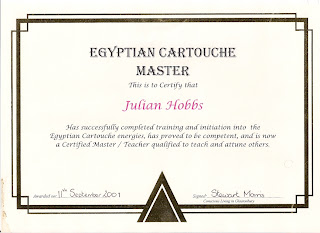
Kundalini Reiki Teacher/ Master

First Ever Reiki Attunement.

Reiki Teacher/ Master

Seichem Teacher/ Master

Egyptian Cartouche Teacher/Master

Kundalini Reiki Teacher/ Master

Wednesday, 15 September 2010
Reiki Forum.
I have made a Reiki Forum @ http://www.reiki-attunements.co.cc/forum For Distance attunement Students but everyone is welcome to join and post.Will be adding lots more information over the next few weeks. Reiki Blessings. Jules.
http://www.reiki-attunements.co.cc/forum
http://www.reiki-attunements.co.cc/forum
Saturday, 17 July 2010
10 Tips on Asking For What You Want & Letting Go To Get It… (via pURe Wellness~Living)
This is a very helpful article, and, for myself a timely reminder. Every step is of equal importance, being open and clear in your energies is one of the secrets to manifesting what we wish. Asking Trusting Action and Receiving, the Universe always responds, and in the most appropriate way.
It reminded me of a well quoted phrase, “you may not always get what you want, but you will always get what you need” The need being an experience that brings us closer into alignment with our Soul, our Higher Self and our Creator.
via pURe Wellness~Living
http://purewellnessliving.com/2010/07/09/10-tips-on-asking-for-what-you-want-letting-go/
It reminded me of a well quoted phrase, “you may not always get what you want, but you will always get what you need” The need being an experience that brings us closer into alignment with our Soul, our Higher Self and our Creator.
– Self Care For The re-emerging/re-inventing herself woman Asking for an answer to a problem, or asking for what I want, has been something I do regularly but what I do that I believe puts a kink in the energy flow hose, is that no sooner do I ask I, my ego/mind, is plotting my answer and the appropriate action. In the past, trust, time, or space has not been given for the answers to bubble up from within. While wandering in the bookstore recent … Read More
via pURe Wellness~Living
http://purewellnessliving.com/2010/07/09/10-tips-on-asking-for-what-you-want-letting-go/
Wednesday, 14 July 2010
Reiki Symbols.
Reiki Symbols.
Reiki CHU-KU-REI
Power Symbol.
This symbol can best be described as the power switch. It also focuses the energy in a particular location. It should be used to empower the other symbols.

Reiki SEI- HE- KE
Mental emotional symbol.
Sei-he-ki is a symbol that we can use for emotional
healing, it can also be used for purification, protection and clearing. Most of the physical manifestations of pain and dis-ease can be linked to the emotions. It is here in the emotional body that lots of painful memories are held, and unless we can begin to release them a physical symptom will begin to manifest itself.
The sei-he-ki is then a very useful tool that we can use for ourselves and for others to help to start to clear the root cause of a problem. It can help us to grow and to let go of things that are holding us back if we are ready.
Personal growth is really a letting go of the things that we no longer need, and making a space in our lives for more light to flow in.
The sei-he-ki can also be used for protection and clearing. I personally use this symbol for cleaning crystals, and it can be used to cleanse, purify and protect any thing that you wish. You can use it on your pets,
jewellery, Food, water, your home, your car, the only limitations are up to you.
To use the sei-he-ki symbol we first draw the chu-ku-rei symbol to connect us with the
source of the REIKI energy and then draw the sei-he-ki over that that we wish to use the energies upon. The sei-he-ki symbol can be used to clear negative thought patterns and emotions. It can also help you to release addictive behavior.

Reiki HON-SHA-ZE-SHO-NEN.
Distance/ Time Space Symbol.
This symbol collapses time and space. It's most common uses in sending distance healing. It also access the mental body.
HON-centre, essence, intrinsic, origin.
SHA-shimmering
ZE-Advancing, evolving, on the correct path.
SHO-Target, objective, honest being, sage, integrity.
NEN-Stillness, thinking in the deep part of the mind.
This symbol collapses time and space, and is most often used in distance healing.
By using this symbol it is possible to send REIKI into the past, or into the future and into other dimensions. It can be used to send REIKI energy to any situation no matter where or when.

Reiki DAI-KOO-MYO
This is the REIKI master symbol.

Some uses for Reiki Symbols.
Clearing crystals with REIKI. Crystals love the REIKI energy, and it makes a nice way of loving and caring for any crystals that you feel drawn to work with. To clean and charge a crystal with REIKI, first use the sei-he-ki symbol. Draw the sei-he-ki over your chosen crystal let the symbol sink in and repeat the process until you feel the crystal is cleansed.
Next draw the chu-ku-rei symbol over the crystal and channel the REIKI energy into the crystal until you feel that it is charged up with energy. You can also dedicate your crystals for specific purposes such as, healing, love or abundance. You can give crystals to people in need of healing to. You can also draw the hon-sha-ze-sho-nen symbol on the crystal if you give it as a gift for people needing healing.
You can also raise the vibration and energy of food and drink in the same way. Draw the chu-ku-rei symbol over your food and drink and say thank you for the food. You can also draw the sei-he-ki over food if you think that is not very fresh or of a poor quality. But don’t depend totally on REIKI if you are not sure then don’t eat it.
The hon-sha-ze-sho-nen symbol is very useful for clearing karmic attachments from the past. If you are troubled by something that you just cannot shift, then sending the hon-shaze- sho-nen symbol into the past and asking that this problem now be healed and released can be very useful.
Thursday, 10 June 2010
Working with the Chakra's, Grounding and Protection.on Chakra's, meditation,
I have published a Guide to Working with the Chakra's, Grounding and Protection. It can be downloaded by following the link below. I hope that you find it useful and helpful. Jules.
Working with the Chakra's, Grounding, Meditation and Protection.
Working with the Chakra's, Grounding, Meditation and Protection.


Wednesday, 9 June 2010
Japanese Reiki Techniques 5. Enkaku Chiryo ho, Ketsueki Kokan ho or Ketsueki Joka-ho, Hanshin Koketsu ho, Zenshin Koketsu ho, Kotodama.
All the following energy techniques are not just for reiki practioners but will enhance any energy work that you do. Great for Healing work, Meditation, Chi Kung or Tai Chi or just to balance your energetic systems.
Enkaku Chiryo ho
“Enkaku Chiryo ho” is our old friend “Distant Reiki” or “Absentia Reiki” that is commonly taught in Usui Shiki Ryoho Level II classes.
There are many methods of doing Distant Healing.
One specific distant technique Usui taught was called “Shashin Chiryo ho” or
Photograph healing. This practice used a photograph of the person as a focus or “proxy” for healing. While having a photograph is nice, anything can be used as a proxy or representation of the person. A printed email would seem to be a “modern” equivalent.
Blood Cleansing Techniques
Ketsueki Kokan ho or Ketsueki Joka-ho
Ketsueki Kokan ho (Ketsueki Joka ho) are called “Blood Cleansing” Techniques. The “Blood Cleansing” techniques were part of Takata Sensei’s teachings as she originally taught. In her notes and diary she describes the “Traditional Reiki Finish” or nerve stroke. In Reiki Ryoho there are two other techniques besides the one Takata Sensei taught.
The idea of “blood cleansing” may seem odd to the westerner. These techniques are thought to cleanse the blood of toxins. It should be pointed out here that Reiki Ryoho was based on meridian theory not unlike Traditional Chinese Medicine and not on chakras as is commonly added into reiki in the west. The meridians stimulated are thought to stimulate new red blood cells to be formed and to bring fresh blood into the area. By bringing fresh blood into the area healing is more rapid. (There is a saying “Where blood flows chi goes; Where chi goes, blood flows”.)
These techniques involve moving the hands along the spine rather than just the laying of hands. Massage laws in the various U.S. states (and in many other parts of the world) began to restrict others from using any technique that could be construed as “manipulative”. As a result, many teachers did not pass along the technique. This is a wonderful and useful part of Reiki and should be taught.
Hanshin Koketsu ho
(Half Body Blood Cleansing)
This is the half body blood cleanse.
Method One
In the first method you are to stroke with the flat of the hand down the arms and legs. First, start at the shoulder and stroke down to the tips of the fingers 15 times. Do both arms. When finished with the arms, start at the outside of the hip and stroke down to the tips of the toes. Again repeat 15 times.
Method Two
It is taught that the upper body be unclothed when doing this. I would advise strong caution and recommend that you not do this unless this is your spouse, significant other, partner or someone else that will not later take offense. These are litigious times and people sue for sexual harassment at the drop of a hat (i.e., Imagine yourself in court explaining to the opposing counsel and jury that you were simply stroking outward on their naked back doing a half body blood exchange….).
Have the person lay on the reiki table with their back unclothed. Some suggest using some light oil, if you start using massage oil it looks suspiciously like you are doing massage).
In this technique both hands are used. Place both hands at the top of the spine with one hand on either side. Start at the top of the neck and stroke outward and slightly down making an outward circular motion. These are small motions from the center of the spine outward to the sides of the body. Do this going down one hand width each time until the entire spine is treated from top to bottom. The entire spine is done 10 to 15 times.
To finish place both hands again at the top of the spine with one hand on either side of the spine. You index finger and thumb are on the muscles that are on either side of the center of the spine. Hold your breath and then with light pressure (not hard!) stroke down the spine from the top of the neck to the base of the spine. End by pressing the fingers lightly (not hard!) into the muscles at the bottom of the spine and then exhale. This entire process is repeated 10 to 15 times.
Zenshin Koketsu ho
Full Body Blood Cleansing
Zenshin Koketsu-ho is the full body blood cleanse.
This is the easiest technique of the “blood cleansing” techniques. Begin by doing the normal positions on the head. Then follow this with the normal hand positions on the chest and the abdomen.
Finish by doing Method One of Hanshin Koketsu ho. (You can do method two instead if you prefer.)
Stroke with the flat of the hand down the arms and legs. First, start at the shoulder and stroke down to the tips of the fingers 15 times. Do both arms. When finished with the arms, start at the outside of the hip and stroke down to the tips of the toes. Again repeat 15 times.
Kotodama
Kotodama and Mantra in Reiki / Kotodama – “Word spirit “
Information is now beginning to come forward that Mikao Usui taught Kotodama to his Okuden (level II) Students. What follows is an explanation of Kotodama. Additionally we will explore the use of Mantra in Reiki and examine some sonnections between Reiki and other energetic arts and practices that developed in the early 1900′s in Japan.
Kotodama (Kotodama) literally means “word spirit”. Although not easily translatable, the most basic idea is that there are words that evoke a spiritual feeling or state. It is a practice of intoning sounds (phonemes or phonetic components of language) to bring about a mystical or spiritual state. There are some that believe that intoning these sounds can direct or harmonize everything in the physical world or bring about a desired outcome in the physical world. This practice is thought to bring about the unification of God, heaven, man and earth.
The kotodama are often thought of as the core sounds of the Universe. You can chant and call forth the respective energies to bring them into balance within yourself:
Here is an example of some of the sounds:
A – Heaven
O – Earth
U – Spirit
E – Mind
I – Void
This idea of sacred syllables is common to many mystical practices including the
Kaballah, Western Magick, Wicca. Mantras or Mantra-yana, which is the use of a sound chanted is a similar practice that is also used to bring about a mystical state.
Mantra practice is common to many meditative practices such as Transcendental
Meditation (TM), Nichiren Buddhism (the “namu myoho renge kyo”), Tibetan Buddhism (the “om mani padme hum”) and many other Indian and eastern traditions. “Mantra” generally refers to Sanskrit words that are sacred words. They might be a verse such as ” om mani padme hum”, or a syllable such as “om” or “mu”. Some of the sounds are thought to be the sounds of a specific deity or a supernatural power.
The practice of Kotodama is to repeat the sacred syllables and intone them. The power of the word spirit resonates in the vocal cords, vibrates the air, spirit, heart and mind of the person directly.
The history of the practice of Kotodama is not entirely clear. Some scholars indicate it is from Shinto origins, while others trace a Shingon Buddhist path. Most likely it is some combination of both as the two religions, ideologies and practices were interwoven through history in Japan.
Kotodama is commonly used in Shinto and Neo-Shinto rites and rituals. It also occurs in Omoto Kyo and Aikido. It is said that Usui taught Kotodama as a spiritual practice at level II (Okuden) in reiki. What is particularly fascinating is the interconnection of this practice to many of the healing practices that were developing at the time that Usui originated Reiki.
Morihei Ueshiba was the founder of Aikido and he incorporated Kotodama into his
Aikido. It is said that he learned the practice in 1919 from Onisaburo Deiguchi who developed the art of Omoto Kyo and then went on to study the practice in Shingon Buddhism. Deiguchi was considered by some to be the leading Kotodama master in the country at that time. Ueshiba was a follower of Omoto-Kyo until his death in 1969.
Another connection to Omoto Kyo occurs in the religion of Johrei. Omoto Kyo was
studied by Mokichi Okada (Meishu Sama) who developed Sei Kai Kyu Sei Kyo better known as Johrei and as the Johrei Fellowship Worldwide. Like Usui’s Reiki, Johrei also uses Reiju to empower its followers.
So what we have here is an interesting concurrence of interconnected circumstances:
* Kotodama is said to be taught by Usui in level II reiki as the means to connect. This was done prior to the symbols being developed.
* The leading Kotodama expert during the time of Usui’s life was Deiguchi.
* Deiguchi’s teachings show up in other energy related healing arts such as Johrei, whose founder, Mokichi Okada, studied with Deiguchi. His Sei Kai Kyu Sei Kyo uses reiju as an empowerment with his followers. This is also the technique used by Usui in his reiki.
* The founder of Aikido, Morihei Ueshiba, also studies with Deiguchi and incorporates Kotodama in his practices. Aikido also used many Ki techniques including developing, strengthening and healing with Ki.
Here are some simple guideline to doing Kotodama or Mantrayana with Reiki.
Some guides to the practice:
Sit in a comfortable chair. You can also sit in the classical Zazen posture if you know it and can sit comfortably in this position. The key is for the back to be straight.
Place the hands on the lap or in the gassho (namaste) position.
Breathe normally through the nose and exhale the syllables through the mouth.
Connect to reiki before starting. Doing hatsurei ho is a good way to do this.
The syllables are said with total concentration and unity of body and spirit. Keep the mind clear and intent pure.
The syllables are voiced slowly, strongly and one at a time. They are separate in pronunciation. Do not slur them together.
For each syllable breathe in through the nose and vocalize out through the mouth.
The sound resonates outward to all the universe.
Japanese Reiki Techniques 4. Hara Chiryo ho – Tanden Chiryo ho, Uchi te, Nada te, Oshi te – patting, stroking, pushing with the hands, Seiheki Chiryo ho.
All the following energy techniques are not just for reiki practioners but will enhance any energy work that you do. Great for Healing work, Meditation, Chi Kung or Tai Chi or just to balance your energetic systems.
Hara Chiryo ho – Tanden Chiryo ho
Hara Chiryo ho is the de-poisoning technique. It is a method that is thought to remove toxins from the body. The hara is thought to be the center of the being. By treating in this fashion you help to “de-poison” toxins from the body. Toxins are often thought of as physical substances, but can also be mental/emotional.
Begin by standing next to the person to be treated. Gassho and calm the mind. Doing the breathing with Gassho technique is a good way to connect to reiki and be mindful. State the intent by saying “I now begin Hara Chiryo ho”. Place one of your hands onto the hara and your other hand on the forehead. Feel the energy in your hands and let it flow. Hold this position until you feel the energy balance
between the hands. Place the hand that is on the forehead onto the hara so that both hands are on the hara. Hold this position for 20 minutes or so, using your intuition to guide you. Finish by doing gassho and giving thanks.
Uchi te, Nada te, Oshi te – patting, stroking, pushing with the hands.
Uchi te Chiryo ho
Uchi te is the technique of patting with the hands. This technique is common to many forms of chi kung (qi gong) and is used to help increase energy flow. It is used where there is numbness or blockage. The force used in patting is light to medium and it is not percussive. It is a soft pat to light slap. The intent of this technique is not to massage the area, but rather to stimulate the body and allow the reiki energy to penetrate into the body.
Nada te Chiryo ho
Nada te is a stroking technique done with the hands. It encourages the energy flow in the body. The hands are placed flat on the body and then moved forward and back or in circles while letting the reiki flow through them which penetrates the body deeply.
Oshi te Chiryo ho
Oshi te is a pushing technique. It is done for stiff areas where there is tightness and causes a loosening. Simply push with the fingertips. Let the reiki energy flow through the tips of the fingers into the stiff areas.
Seiheki Chiryo ho
Seiheki Chiryo-ho is the way of treating habits or natural tendencies. This is used to place a message into the subconscious of the person you are treating. This can be done as a self treatment as well. This technique can be used to overcome bad habits, to focus the mind on something important (such as living the reiki principles), or for achieving a goal.
The first step is to talk to the person to be treated. If the person to be treated is you, it is honest self talk. If you are treating another person discuss with them what it is that they wish to work on. Once you know what it is they wish to accomplish you must develop a simple affirmation(s) that you will use. Affirmations should always be stated in the positive as if they have already occurred. For
example, if they are going to quit smoking you would want to say, “I am smoke free and healthy” rather than “I will stop smoking and feel better”.
Next, have the person to be treated lay down and close their eyes. Instruct them to breath smoothly and slowly through the nose, so that they are calm and
receptive. If you are treating yourself you can lay down or simply sit in a chair. The key here is relaxation.
Do Gassho. Calm your mind. Be mindful. Starting with a breathing with gassho
exercise is helpful to connect to reiki and focus the mind. State your intent by saying to yourself, “I now begin Seiheki Chiryo-ho”.
Place one hand on the forehead and the other hand on the back of the head. I prefer to place my dominant hand on the forehead but this is simply my preference. It feels more “natural” to me.
With the mind focused and clear and with intent less intent ask that the person being treated be free of what you are treating. You then repeat the affirmations you have chosen. This can be done silently to oneself or out loud. Feel the reiki flow knowing it is healing and bringing balance and wholeness.
Remove your hand that is on the forehead while keeping the other hand on the back of the head. Stop repeating the affirmations but continue to let the reiki flow. Stay in this position for several minutes.
Finish by doing Gassho and saying thanks. It is taught that repeated treatments are more beneficial than one, or doing a long treatment.
Hara Chiryo ho – Tanden Chiryo ho
Hara Chiryo ho is the de-poisoning technique. It is a method that is thought to remove toxins from the body. The hara is thought to be the center of the being. By treating in this fashion you help to “de-poison” toxins from the body. Toxins are often thought of as physical substances, but can also be mental/emotional.
Begin by standing next to the person to be treated. Gassho and calm the mind. Doing the breathing with Gassho technique is a good way to connect to reiki and be mindful. State the intent by saying “I now begin Hara Chiryo ho”. Place one of your hands onto the hara and your other hand on the forehead. Feel the energy in your hands and let it flow. Hold this position until you feel the energy balance
between the hands. Place the hand that is on the forehead onto the hara so that both hands are on the hara. Hold this position for 20 minutes or so, using your intuition to guide you. Finish by doing gassho and giving thanks.
Uchi te, Nada te, Oshi te – patting, stroking, pushing with the hands.
Uchi te Chiryo ho
Uchi te is the technique of patting with the hands. This technique is common to many forms of chi kung (qi gong) and is used to help increase energy flow. It is used where there is numbness or blockage. The force used in patting is light to medium and it is not percussive. It is a soft pat to light slap. The intent of this technique is not to massage the area, but rather to stimulate the body and allow the reiki energy to penetrate into the body.
Nada te Chiryo ho
Nada te is a stroking technique done with the hands. It encourages the energy flow in the body. The hands are placed flat on the body and then moved forward and back or in circles while letting the reiki flow through them which penetrates the body deeply.
Oshi te Chiryo ho
Oshi te is a pushing technique. It is done for stiff areas where there is tightness and causes a loosening. Simply push with the fingertips. Let the reiki energy flow through the tips of the fingers into the stiff areas.
Seiheki Chiryo ho
Seiheki Chiryo-ho is the way of treating habits or natural tendencies. This is used to place a message into the subconscious of the person you are treating. This can be done as a self treatment as well. This technique can be used to overcome bad habits, to focus the mind on something important (such as living the reiki principles), or for achieving a goal.
The first step is to talk to the person to be treated. If the person to be treated is you, it is honest self talk. If you are treating another person discuss with them what it is that they wish to work on. Once you know what it is they wish to accomplish you must develop a simple affirmation(s) that you will use. Affirmations should always be stated in the positive as if they have already occurred. For
example, if they are going to quit smoking you would want to say, “I am smoke free and healthy” rather than “I will stop smoking and feel better”.
Next, have the person to be treated lay down and close their eyes. Instruct them to breath smoothly and slowly through the nose, so that they are calm and
receptive. If you are treating yourself you can lay down or simply sit in a chair. The key here is relaxation.
Do Gassho. Calm your mind. Be mindful. Starting with a breathing with gassho
exercise is helpful to connect to reiki and focus the mind. State your intent by saying to yourself, “I now begin Seiheki Chiryo-ho”.
Place one hand on the forehead and the other hand on the back of the head. I prefer to place my dominant hand on the forehead but this is simply my preference. It feels more “natural” to me.
With the mind focused and clear and with intent less intent ask that the person being treated be free of what you are treating. You then repeat the affirmations you have chosen. This can be done silently to oneself or out loud. Feel the reiki flow knowing it is healing and bringing balance and wholeness.
Remove your hand that is on the forehead while keeping the other hand on the back of the head. Stop repeating the affirmations but continue to let the reiki flow. Stay in this position for several minutes.
Finish by doing Gassho and saying thanks. It is taught that repeated treatments are more beneficial than one, or doing a long treatment.
Tuesday, 1 June 2010
Finding a Reiki Teacher
One of the questions I get asked the most is..............................How do I find and choose a reputable Teacher to learn Reiki with ?
Learning Reiki and participating in Reiki Attunements is a very personal and empowering thing to do in Your life. A Teachers task is to instil in the Student the connection, confidence, ability and knowledge to use this wonderful gift. We all have different ways of learning new skills, and a good Teacher will tailor the learning process so it suits your acuity best. Some people learn best by hands on experience, needing the tactile sensations and feedback to understand. Another, might learn best by reading and study, or by listening and seeing. A good Teacher will ensure that all the instruction and experience is presented to the student in a clear, easily understood way.
There are many people who now teach Reiki, and many of them advertise their services openly. You can search the internet, attend Mind Body Spirit fairs, look in New Age shops, visit healing centres and ask your friends for personnel recommendations. Being a Spiritual self improvement modality, your inner guidance, trust and openness will be of great assistance. One much quoted teaching states " When the Student is ready..............The Teacher will appear"
Having found some suitable and knowledgeable Teachers it is very worthwhile finding a little more about them. Checking their Qualifications if that is important to you and contacting other people they have taught before. I would recommend a personnel visit if possible. I Myself would always address any questions a Student may have, and give them a reiki healing so they might have first hand experience and be able to energetically feel if I was the person they would like to teach and attune them to Reiki. I would outline what would be covered, show then a copy of the manual and certificates, let them know of any previous students that lived close to them.
A typical teaching day for me would be:-
Meeting and greeting the Student.
An out-line of the days activities.
A beginning meditation to create a sacred space and Spirits assistance.
The history of Reiki and My Linage.
Good healing session practices.
Professional codes and conduct.
Record keeping, insurance and building a client base.
The Reiki symbols and methods for connection to the Reiki Source.
Hand positions and other helpful advice on giving Reiki Healings to others.
The actual Attunement itself.
Teachings on the Aura, Chakra's, Human Energy System, Meditation, Grounding, Protection and working in a sacred space.
A Reiki practise healing swap.
A Reiki healing for the Student to assist in integrating the energetic transmissions.
Any questions the Student had answered to the best of my ability and wisdom.
Presentation of Manual and Certification.
I would always offer support, advice and feedback. The most important thing for me was to instil the confidence in the Student to go out into the World and use their new abilities to assist others.
I hope this article has been helpful, Jules.
Learning Reiki and participating in Reiki Attunements is a very personal and empowering thing to do in Your life. A Teachers task is to instil in the Student the connection, confidence, ability and knowledge to use this wonderful gift. We all have different ways of learning new skills, and a good Teacher will tailor the learning process so it suits your acuity best. Some people learn best by hands on experience, needing the tactile sensations and feedback to understand. Another, might learn best by reading and study, or by listening and seeing. A good Teacher will ensure that all the instruction and experience is presented to the student in a clear, easily understood way.
There are many people who now teach Reiki, and many of them advertise their services openly. You can search the internet, attend Mind Body Spirit fairs, look in New Age shops, visit healing centres and ask your friends for personnel recommendations. Being a Spiritual self improvement modality, your inner guidance, trust and openness will be of great assistance. One much quoted teaching states " When the Student is ready..............The Teacher will appear"
Having found some suitable and knowledgeable Teachers it is very worthwhile finding a little more about them. Checking their Qualifications if that is important to you and contacting other people they have taught before. I would recommend a personnel visit if possible. I Myself would always address any questions a Student may have, and give them a reiki healing so they might have first hand experience and be able to energetically feel if I was the person they would like to teach and attune them to Reiki. I would outline what would be covered, show then a copy of the manual and certificates, let them know of any previous students that lived close to them.
A typical teaching day for me would be:-
Meeting and greeting the Student.
An out-line of the days activities.
A beginning meditation to create a sacred space and Spirits assistance.
The history of Reiki and My Linage.
Good healing session practices.
Professional codes and conduct.
Record keeping, insurance and building a client base.
The Reiki symbols and methods for connection to the Reiki Source.
Hand positions and other helpful advice on giving Reiki Healings to others.
The actual Attunement itself.
Teachings on the Aura, Chakra's, Human Energy System, Meditation, Grounding, Protection and working in a sacred space.
A Reiki practise healing swap.
A Reiki healing for the Student to assist in integrating the energetic transmissions.
Any questions the Student had answered to the best of my ability and wisdom.
Presentation of Manual and Certification.
I would always offer support, advice and feedback. The most important thing for me was to instil the confidence in the Student to go out into the World and use their new abilities to assist others.
I hope this article has been helpful, Jules.
Thursday, 11 February 2010
Japanese Reiki Techniques 3. Koki ho - Healing with Breath. Gyoshi ho - Healing with the Eyes. Heso Chiryo ho.
All the following energy techniques are not just for reiki practioners but will enhance any energy work that you do. Great for Healing work, Meditation, Chi Kung or Tai Chi or just to balance your energetic systems.
Koki ho - Healing with Breath
"Koki-ho" means the way of healing with the breath. This technique does not seem to have directly survived in Takata Sensei's teachings. It indirectly
appears in many attunement sets where the Reiki Master "blows" the energy or symbols into the student. This technique is very useful to treat people that cannot be touched such as a burn or accident victim. It is also useful for those who do not want touch, such as someone that has been abused.
This is a focused way of healing with the breath. After connecting to reiki, breathe in through the nose. Gently blow out through the mouth with lips pursed. If you are unsure how to do this (laughs) watch a smoker exhale. The lips form a small round opening that the breath flows through. When doing this feel the reiki as you breathe in. Some "see" the reiki as a white light or mist that they are breathing in. You may feel the heat on the lungs, mouth and throat.
Gyoshi ho - Healing with the Eyes
"Gyoshi-ho" means the way of healing with the eyes. This technique does not seem to have survived in Takata Sensei's teachings. Energy flows from the entire body. You experience this directly when doing "Jyoshin Koki-ho" section in Hatsurei ho. It is said that energy emanates most strongly from the hands and this is why touch healing (te-ate) is taught first in Reiki. Energy also emanates strongly from the eyes and the breath. This technique teaches you to send reiki with the eyes. Like Ko Ki ho, this technique is very useful to treat people that cannot be touched such as a burn, accident or abuse victim. The essential part of this technique is that the look is compassion. For those with Christian backgrounds think of a look that you have seen in a picture of Jesus of Mary. For those who have seen Kuan Yin statues think of the look of total compassion. The look is not a "stare", but a soft, relaxed, defocused look. It is said that all reiki is Karuna (compassionate action) and Metta (loving kindness). The essence of your being is loving kindness for all, your look is total compassion, reiki radiating out from the eyes.
This technique is simplicity itself. Simply look at where you wish to send.
Connect to reiki. You are reiki. With eyes relaxed, radiating loving kindness and compassion to all, feel the reiki flow through the eyes to the person you are treating. See or visualize the energy flowing into where you are looking. Just be reiki. You can move to various places to treat or simply know and intend that it goes where it will.
Heso Chiryo ho
Heso Chiryo ho is the way of naval healing. The hara is thought to be the center of the being. The naval sits above this and thus this is considered an important point in healing all diseases.
Begin by standing next to the person to be treated. Gassho and calm the mind. Doing the breathing with Gassho technique is a good way to connect to reiki and be mindful. State the intent by saying "I now begin Heso Chiryo ho". Place one hand over the naval with the tip of the middle finger in the naval. Feel for the pulse. When you feel the pulse you are becoming in resonance with the universal energy. Continue for about 5 minutes or so, until you feel relaxed and in balance and harmony. Finish by doing gassho and giving thanks.
Koki ho - Healing with Breath
"Koki-ho" means the way of healing with the breath. This technique does not seem to have directly survived in Takata Sensei's teachings. It indirectly
appears in many attunement sets where the Reiki Master "blows" the energy or symbols into the student. This technique is very useful to treat people that cannot be touched such as a burn or accident victim. It is also useful for those who do not want touch, such as someone that has been abused.
This is a focused way of healing with the breath. After connecting to reiki, breathe in through the nose. Gently blow out through the mouth with lips pursed. If you are unsure how to do this (laughs) watch a smoker exhale. The lips form a small round opening that the breath flows through. When doing this feel the reiki as you breathe in. Some "see" the reiki as a white light or mist that they are breathing in. You may feel the heat on the lungs, mouth and throat.
Gyoshi ho - Healing with the Eyes
"Gyoshi-ho" means the way of healing with the eyes. This technique does not seem to have survived in Takata Sensei's teachings. Energy flows from the entire body. You experience this directly when doing "Jyoshin Koki-ho" section in Hatsurei ho. It is said that energy emanates most strongly from the hands and this is why touch healing (te-ate) is taught first in Reiki. Energy also emanates strongly from the eyes and the breath. This technique teaches you to send reiki with the eyes. Like Ko Ki ho, this technique is very useful to treat people that cannot be touched such as a burn, accident or abuse victim. The essential part of this technique is that the look is compassion. For those with Christian backgrounds think of a look that you have seen in a picture of Jesus of Mary. For those who have seen Kuan Yin statues think of the look of total compassion. The look is not a "stare", but a soft, relaxed, defocused look. It is said that all reiki is Karuna (compassionate action) and Metta (loving kindness). The essence of your being is loving kindness for all, your look is total compassion, reiki radiating out from the eyes.
This technique is simplicity itself. Simply look at where you wish to send.
Connect to reiki. You are reiki. With eyes relaxed, radiating loving kindness and compassion to all, feel the reiki flow through the eyes to the person you are treating. See or visualize the energy flowing into where you are looking. Just be reiki. You can move to various places to treat or simply know and intend that it goes where it will.
Heso Chiryo ho
Heso Chiryo ho is the way of naval healing. The hara is thought to be the center of the being. The naval sits above this and thus this is considered an important point in healing all diseases.
Begin by standing next to the person to be treated. Gassho and calm the mind. Doing the breathing with Gassho technique is a good way to connect to reiki and be mindful. State the intent by saying "I now begin Heso Chiryo ho". Place one hand over the naval with the tip of the middle finger in the naval. Feel for the pulse. When you feel the pulse you are becoming in resonance with the universal energy. Continue for about 5 minutes or so, until you feel relaxed and in balance and harmony. Finish by doing gassho and giving thanks.
Wednesday, 10 February 2010
Japanese Reiki Techniques 2 Jyoshin Koki-ho. Gassho. Seishin Toitsu. Reiki Principles. Mokunen.
All the following energy techniques are not just for reiki practioners but will enhance any energy work that you do. Great for Healing work, Meditation, Chi Kung or Tai Chi or just to balance your energetic systems.
Jyoshin Koki-ho
Jyoshin Koki-ho (Joshin Kokyo-ho) is a breathing technique. You breathe reiki in through the nose through the crown and into the hara on the in breath. You breath the out breath from the hara. This technique is part meditation, part hara energization, and is done to cleanse the spirit.
Jyoshin Kokiho is done to cleanse the spirit, heart and mind. It is a focus
meditative breathing technique. To do Jyoshin start by placing the hands in Gassho and your eyes closed. Breathe in through the nose and out through the mouth. On the in breath, breathe in the light of reiki through the crown and into the hara. Let the light fill your body completely transmuting all that is
negative and stuck into light. This relieves tension, anxiety, and promotes calm. On the out breath, breathe out that light and radiate it from you to all the
universe.
Gassho
Gassho is a common practice in many eastern traditions. It is called "Namaste" in the Indo- Tibetan traditions. Gassho is holding the hands clasped in a prayer position at about the level of the chest. In reiki, Gassho is formally practiced by sitting on the floor or on a chair. The hands are in the prayer clasped position with the middle fingers touching in front of the chest.
The eyes are closed. The reiki precepts are said (For today only do not anger, do not worry, be grateful, do your work with appreciation, be kind to all people).
The middle fingers touch as this completes the meridians that terminate in the hands, in particular the fire element terminates at the tip of the middle finger. (Some call this the "reiki laser".)
Seishin Toitsu - mindfulness meditation
You are in the Gassho or namaste position. This technique involves breathing through the hands. On the inhalation breathe in through the hands. See the reiki light that flows into the hands move in to the hara or hara line. Your hara is filled with light. Some see the hara as a fire of white light and as they breathe in this reiki light the light and fire increases in the hara.
On the exhalation see the energy moving back out through the hands. The light and energy in the hara remains with you.
You will find that the hara and hands become quite warm when doing this.
Continue until you feel done.
(N.B. When done in a group, it is at this point that the Teacher will do "reiju" or an empowerment/attunement. This group practice of Hatsurei ho is called "Shuyo ho".)
Reiki Principles
The reiki principles are said as affirmations at this point. They are referred to as "Gokai Sansho" and are said three times.
For today only;
anger not,
worry not.
Be Humble.
With gratitude work on yourself.
Be kind to all.
Mokunen
Mokunen sets the intent of focus of concluding Hatsurei ho. To do Mokunen, say with the mind clear "I am done with Hatsurei now". This is said to the mind and subconscious, but let it reverberate everywhere.
Jyoshin Koki-ho
Jyoshin Koki-ho (Joshin Kokyo-ho) is a breathing technique. You breathe reiki in through the nose through the crown and into the hara on the in breath. You breath the out breath from the hara. This technique is part meditation, part hara energization, and is done to cleanse the spirit.
Jyoshin Kokiho is done to cleanse the spirit, heart and mind. It is a focus
meditative breathing technique. To do Jyoshin start by placing the hands in Gassho and your eyes closed. Breathe in through the nose and out through the mouth. On the in breath, breathe in the light of reiki through the crown and into the hara. Let the light fill your body completely transmuting all that is
negative and stuck into light. This relieves tension, anxiety, and promotes calm. On the out breath, breathe out that light and radiate it from you to all the
universe.
Gassho
Gassho is a common practice in many eastern traditions. It is called "Namaste" in the Indo- Tibetan traditions. Gassho is holding the hands clasped in a prayer position at about the level of the chest. In reiki, Gassho is formally practiced by sitting on the floor or on a chair. The hands are in the prayer clasped position with the middle fingers touching in front of the chest.
The eyes are closed. The reiki precepts are said (For today only do not anger, do not worry, be grateful, do your work with appreciation, be kind to all people).
The middle fingers touch as this completes the meridians that terminate in the hands, in particular the fire element terminates at the tip of the middle finger. (Some call this the "reiki laser".)
Seishin Toitsu - mindfulness meditation
You are in the Gassho or namaste position. This technique involves breathing through the hands. On the inhalation breathe in through the hands. See the reiki light that flows into the hands move in to the hara or hara line. Your hara is filled with light. Some see the hara as a fire of white light and as they breathe in this reiki light the light and fire increases in the hara.
On the exhalation see the energy moving back out through the hands. The light and energy in the hara remains with you.
You will find that the hara and hands become quite warm when doing this.
Continue until you feel done.
(N.B. When done in a group, it is at this point that the Teacher will do "reiju" or an empowerment/attunement. This group practice of Hatsurei ho is called "Shuyo ho".)
Reiki Principles
The reiki principles are said as affirmations at this point. They are referred to as "Gokai Sansho" and are said three times.
For today only;
anger not,
worry not.
Be Humble.
With gratitude work on yourself.
Be kind to all.
Mokunen
Mokunen sets the intent of focus of concluding Hatsurei ho. To do Mokunen, say with the mind clear "I am done with Hatsurei now". This is said to the mind and subconscious, but let it reverberate everywhere.
Japanese reiki techniques 1 Gyosei. Kihon Shisei. Mokunen and Kenyoku-ho.
All the following energy techniques are not just for reiki practioners but will enhance any energy work that you do. Great for Healing work, Meditation, Chi Kung or Tai Chi or just to balance your energetic systems.
Hatsurei ho is the Jewel of Reiki. This technique is part mindfulness
meditation, part strengthening the reiki channel, and part self empowerment.
It is said to be the cornerstone of Usui's practices and was taught to all
Second level students. There are some sources that report that it was taught as separate techniques to Shoden (Level One) students as they progressed.
Hatsurei ho contained the following techniques:
* Preparation -clearing the mind - Gyosei
* Kihon Shisei - beginning position
* Mokunen - setting the intent and focus
* Kenyoku ho - Dry bathing
* Joshin Koku ho - The Cleansing Breath
* Gassho - meditation posture and breathing technique
* Seishin Toitsu - mindfulness meditation
* Reiki Principles
* Mokunen
Preparation - Clearing the mind
The first part of doing Hatsurei ho is to clear the mind. In Usui's Reiki Ryoho this was done by singing Gyosei. These were the stylized poetry as composed by the Meiji Emperor.
They were chanted/sung in a very specific way. The chant, cadence, and rhythm
help develop mindfulness and clear the mind.
Kihon Shisei
Kihon Shisei is the beginning position. The traditional position would be to sit in zazen style. Since few of us in the west have had practice and experience
sitting this way, it might be uncomfortable and become a distraction. You might find a straight backed chair to be more comfortable and suited to your needs. The important element is sitting up with the back straight. The eyes are gently closed. Your focus is into the lower abdomen.
This is called the Hara in Japanese and is referred to as the Tan Tien (dan tien, tan dien) in other places. You hands are placed gently in the lap.
Mokunen
Mokunen sets the intent of focus. To do Mokunen clear the mind and with
mindfulness say, "I am beginning Hatsurei now". This is said to the mind and subconscious, but let it reverberate everywhere.
Kenyoku-ho
Kenyoku-ho (dry bathing) is a technique to clear and strengthen the energy channels. The technique was common to many martial arts and chi kung schools such as JuJitsu, Aikido and KiKo and was added by Usui. It is likely that this technique comes from the rituals of Shinto priests. The ritual action was to cleanse the body before contacting the deity.
Those familiar with the martial arts will recognize the two parts of this
technique as common techniques. The first is a down block across the
midsection (this technique is used in a variety of martial arts such as Karate, Kung Fu, Aikido, etc.). This down block is followed by what is commonly called in the martial arts as a "shirk" or technique to remove an opponents hand from your wrist that is done by sliding the knife edge of your hand down the arm.
A. Place your right hand on the left shoulder so that the right fingertips are on the left shoulder. The hand is open, the fingers held together all point upwards. The hand (palm down) is against the body.
B. Slide the hand downward toward the right hip. Move the hand, going across the chest and ending up fingers down at the right hip. The hand (palm down) stays in light contact with the body the entire movement. (This is what is called an open handed down block in the martial arts)
C. Repeat this process starting with the left hand on the right shoulder and
going down to the left hip.
D. Place the right hand again on the left shoulder. Slide the right hand down the left arm (inside or outside, each will cover different meridians - see below) all the way to the finger tips. (This is what would be called a "shirk" in the martial arts, used to remove an opponents hand that is grabbing your arm.)
E. Repeat this with the left hand on the right arm.
F. Start with the right hand on the inside of the left elbow, and slide the hand down to the fingertips.
G. Repeat this with the left hand on the right inside of the elbow.
Note - Some masters teach the hand should slide to the inside of the arm and others teach it should slide down the outside of the arm. Different meridians are stimulated for each. The inside slide is yin and will effect the lung, heart, and kidney meridians. The outside slide is yang and will effect the triple
warmer, colon and small intestine meridians.
It is interesting that this technique appears to have survived after a fashion in the Rand school that teaches to cut the cords on the solar plexus using a "karate chopping technique".
Hatsurei ho is the Jewel of Reiki. This technique is part mindfulness
meditation, part strengthening the reiki channel, and part self empowerment.
It is said to be the cornerstone of Usui's practices and was taught to all
Second level students. There are some sources that report that it was taught as separate techniques to Shoden (Level One) students as they progressed.
Hatsurei ho contained the following techniques:
* Preparation -clearing the mind - Gyosei
* Kihon Shisei - beginning position
* Mokunen - setting the intent and focus
* Kenyoku ho - Dry bathing
* Joshin Koku ho - The Cleansing Breath
* Gassho - meditation posture and breathing technique
* Seishin Toitsu - mindfulness meditation
* Reiki Principles
* Mokunen
Preparation - Clearing the mind
The first part of doing Hatsurei ho is to clear the mind. In Usui's Reiki Ryoho this was done by singing Gyosei. These were the stylized poetry as composed by the Meiji Emperor.
They were chanted/sung in a very specific way. The chant, cadence, and rhythm
help develop mindfulness and clear the mind.
Kihon Shisei
Kihon Shisei is the beginning position. The traditional position would be to sit in zazen style. Since few of us in the west have had practice and experience
sitting this way, it might be uncomfortable and become a distraction. You might find a straight backed chair to be more comfortable and suited to your needs. The important element is sitting up with the back straight. The eyes are gently closed. Your focus is into the lower abdomen.
This is called the Hara in Japanese and is referred to as the Tan Tien (dan tien, tan dien) in other places. You hands are placed gently in the lap.
Mokunen
Mokunen sets the intent of focus. To do Mokunen clear the mind and with
mindfulness say, "I am beginning Hatsurei now". This is said to the mind and subconscious, but let it reverberate everywhere.
Kenyoku-ho
Kenyoku-ho (dry bathing) is a technique to clear and strengthen the energy channels. The technique was common to many martial arts and chi kung schools such as JuJitsu, Aikido and KiKo and was added by Usui. It is likely that this technique comes from the rituals of Shinto priests. The ritual action was to cleanse the body before contacting the deity.
Those familiar with the martial arts will recognize the two parts of this
technique as common techniques. The first is a down block across the
midsection (this technique is used in a variety of martial arts such as Karate, Kung Fu, Aikido, etc.). This down block is followed by what is commonly called in the martial arts as a "shirk" or technique to remove an opponents hand from your wrist that is done by sliding the knife edge of your hand down the arm.
A. Place your right hand on the left shoulder so that the right fingertips are on the left shoulder. The hand is open, the fingers held together all point upwards. The hand (palm down) is against the body.
B. Slide the hand downward toward the right hip. Move the hand, going across the chest and ending up fingers down at the right hip. The hand (palm down) stays in light contact with the body the entire movement. (This is what is called an open handed down block in the martial arts)
C. Repeat this process starting with the left hand on the right shoulder and
going down to the left hip.
D. Place the right hand again on the left shoulder. Slide the right hand down the left arm (inside or outside, each will cover different meridians - see below) all the way to the finger tips. (This is what would be called a "shirk" in the martial arts, used to remove an opponents hand that is grabbing your arm.)
E. Repeat this with the left hand on the right arm.
F. Start with the right hand on the inside of the left elbow, and slide the hand down to the fingertips.
G. Repeat this with the left hand on the right inside of the elbow.
Note - Some masters teach the hand should slide to the inside of the arm and others teach it should slide down the outside of the arm. Different meridians are stimulated for each. The inside slide is yin and will effect the lung, heart, and kidney meridians. The outside slide is yang and will effect the triple
warmer, colon and small intestine meridians.
It is interesting that this technique appears to have survived after a fashion in the Rand school that teaches to cut the cords on the solar plexus using a "karate chopping technique".
Friday, 13 November 2009
Basic Chakra Meditations.
When working with energy it is very important to ground your-self and to set up a protected space.
If you're familiar with the positions of the Chakra system on the physical body, you can begin to practice opening and closing of the Chakra's.
The Chakra's will open and close naturally, but in most people they tend to be either too open or too closed. Regular practice of these exercises will help to restore balance and your Chakra's will open and close naturally according to the situations that you find yourself in.
I find that most people can visualize a Chakra Centre as a rose flower. When the Chakra is closed, you can imagine the Rose as a small tight bud, in perhaps a golden colour. If you wish to open a Chakra you can imagine the bud opening up and the petals unfolding. You may wish to try this exercise and see if it's suitable for you. You can use the Reiki energy to balance and harmonise the Chakra's as well.
To begin with the opening and closing of the Chakra’s sit down in a quiet safe space ground and centre yourself.
Find the physical location of the base Chakra at the root of the spine, opening downwards. Imagine this Chakra as a beautiful golden Rose bud, and then imagine the rosebud slowly unfolding and the petals opening out.
You can then move up the rest of the Chakra system and imagine the Chakra's opening in this way. See if you can feel any sensations as you work with your chakras in this way.
If you wish to close your energy centers down, then imagine the Golden Rose flower shrinking down into a tiny bud. Regular practice of this exercise will be very helpful.
Another way to work with the chakras is to run light through them. This helps to clean them and to energise and balance them all. To work with light to energise the Chakra's sit comfortably either on the floor with your spine straight or in a chair with you feet firmly on the ground.
Ground yourself into Mother Earth, and set up your protection.
Taking a few slow deep breaths into your lower abdomen. Relaxing gently, imagine a beautiful White or Gold light above your head. Feel the light entering your crown chakra, see if you can any sensations of this energy.
Imagine the light flowing from your crown Chakra into your third eye Chakra and radiating out from both the front and rear of this Chakra.
Then move the light slowly down into throat Chakra and feel the light radiating out of the front and back of your throat Chakra.
Move down to your heart Chakra feel the light radiating out of the front and back of your heart Chakra.
Then move the light down into your solar plexus Chakra and feel the light radiating out of the front and back of the solar plexus Chakra.
Then move the light into the naval Chakra and then feel the light radiating out of the front and back of the navel Chakra.
Moving the light down into your base chakra and moving down your grounding cord and into Mother Earth.
When you feel it's time to finish, imagine the light moving back up your grounding cord into the base chakra, then on up into your naval Chakra and imagine the naval Chakra closing down.
Imagine the light moving up into the solar plexus Chakra, and the solar plexus closing down.
Move the light up into your heart Chakra and slowly close this Chakra. The light moves up into throat Chakra and the throat Chakra slowly closes down.
Move the light into the third eye Chakra and imagine this Chakra closing down.
Then move the light back into your crown Chakra and feel this Chakra close, as the light moves on out of the top of head.
As well as well as doing the exercise by calling light down from above, you can also bring white light up from the center of the earth.
This method involves bringing light up through you're grounding cord into each of your chakra's and then back down again, closing each Chakra as the light moves down. Don’t forget to ground yourself and check your protection when you have finished the meditation.
You can also concentrate on each of the Charka’s separately in a meditation session.
For example if you feel you have a weakness in a certain Chakra, you can meditate on that Chakra either by running light through it, or by using that chakra's complimentary colour to calm or energise it. To do so is helpful if you can have some colours that relate to the Chakra sit in a meditative space grounded and protected and concentrate on the chosen colour.
If you feel you have a block with your solar plexus Chakra, find or imagine a yellow colour to energise it, or a violet colour to calm it.
To meditate with colours in this way imagine that you are surrounded by the chosen colour and see it as a fine mist. With every breath you take imagine you are breathing in this colour. When you have finished, imagine this mist turning back to white and breathe this in for a few minutes. Colours have a very strong effect on our energies and emotions, if at any time you feel any distress when doing colour breathing, just imagine the coloured mist changing to white and breathe this in for a few minutes to restore balance.
I hope you have found this Guide useful and informative.
Jules.

FVPPSC4UC4NX
If you're familiar with the positions of the Chakra system on the physical body, you can begin to practice opening and closing of the Chakra's.
The Chakra's will open and close naturally, but in most people they tend to be either too open or too closed. Regular practice of these exercises will help to restore balance and your Chakra's will open and close naturally according to the situations that you find yourself in.
I find that most people can visualize a Chakra Centre as a rose flower. When the Chakra is closed, you can imagine the Rose as a small tight bud, in perhaps a golden colour. If you wish to open a Chakra you can imagine the bud opening up and the petals unfolding. You may wish to try this exercise and see if it's suitable for you. You can use the Reiki energy to balance and harmonise the Chakra's as well.
To begin with the opening and closing of the Chakra’s sit down in a quiet safe space ground and centre yourself.
Find the physical location of the base Chakra at the root of the spine, opening downwards. Imagine this Chakra as a beautiful golden Rose bud, and then imagine the rosebud slowly unfolding and the petals opening out.
You can then move up the rest of the Chakra system and imagine the Chakra's opening in this way. See if you can feel any sensations as you work with your chakras in this way.
If you wish to close your energy centers down, then imagine the Golden Rose flower shrinking down into a tiny bud. Regular practice of this exercise will be very helpful.
Another way to work with the chakras is to run light through them. This helps to clean them and to energise and balance them all. To work with light to energise the Chakra's sit comfortably either on the floor with your spine straight or in a chair with you feet firmly on the ground.
Ground yourself into Mother Earth, and set up your protection.
Taking a few slow deep breaths into your lower abdomen. Relaxing gently, imagine a beautiful White or Gold light above your head. Feel the light entering your crown chakra, see if you can any sensations of this energy.
Imagine the light flowing from your crown Chakra into your third eye Chakra and radiating out from both the front and rear of this Chakra.
Then move the light slowly down into throat Chakra and feel the light radiating out of the front and back of your throat Chakra.
Move down to your heart Chakra feel the light radiating out of the front and back of your heart Chakra.
Then move the light down into your solar plexus Chakra and feel the light radiating out of the front and back of the solar plexus Chakra.
Then move the light into the naval Chakra and then feel the light radiating out of the front and back of the navel Chakra.
Moving the light down into your base chakra and moving down your grounding cord and into Mother Earth.
When you feel it's time to finish, imagine the light moving back up your grounding cord into the base chakra, then on up into your naval Chakra and imagine the naval Chakra closing down.
Imagine the light moving up into the solar plexus Chakra, and the solar plexus closing down.
Move the light up into your heart Chakra and slowly close this Chakra. The light moves up into throat Chakra and the throat Chakra slowly closes down.
Move the light into the third eye Chakra and imagine this Chakra closing down.
Then move the light back into your crown Chakra and feel this Chakra close, as the light moves on out of the top of head.
As well as well as doing the exercise by calling light down from above, you can also bring white light up from the center of the earth.
This method involves bringing light up through you're grounding cord into each of your chakra's and then back down again, closing each Chakra as the light moves down. Don’t forget to ground yourself and check your protection when you have finished the meditation.
You can also concentrate on each of the Charka’s separately in a meditation session.
For example if you feel you have a weakness in a certain Chakra, you can meditate on that Chakra either by running light through it, or by using that chakra's complimentary colour to calm or energise it. To do so is helpful if you can have some colours that relate to the Chakra sit in a meditative space grounded and protected and concentrate on the chosen colour.
If you feel you have a block with your solar plexus Chakra, find or imagine a yellow colour to energise it, or a violet colour to calm it.
To meditate with colours in this way imagine that you are surrounded by the chosen colour and see it as a fine mist. With every breath you take imagine you are breathing in this colour. When you have finished, imagine this mist turning back to white and breathe this in for a few minutes. Colours have a very strong effect on our energies and emotions, if at any time you feel any distress when doing colour breathing, just imagine the coloured mist changing to white and breathe this in for a few minutes to restore balance.
I hope you have found this Guide useful and informative.
Jules.
FVPPSC4UC4NX
The Crown Chakra.
The Crown Chakra is the Chakra that activates and opens at us up to the higher consciousness. The two basic energies of duality, which we name masculine and feminine, unite, bond and transcends at this Chakra creating (when it is active ) a super consciousness that is beyond time and space. In the Super consciousness a process of unification occurs between you the Human personality and Higher Self.
When you begin to have been even a small glimpse of what these words mean, it is like an enormous power being lit up in the mind. People have described his experience in many different ways. “The top of my head felt as if it was splitting”, “ a fountain of divine light flowed in-and-out”, “I was taken into the light”. Once be begin to have these kind of experiences, there is no going back. Mundane everyday life is forever changed and we see everything as a play of subtle energies. Influencing the head, this Chakra opens upwards. It connects deep within the brain to the pineal gland, which is an important key to our biological clock. The pineal gland, and the gonads (prostate/ testes or ovaries/ uterus at the base Chakra work closely together to regulate sexual growth at puberty.
The pineal gland produces a hormone called melatonin, which regulates the light reactive photoreceptors in the retina of the eye. Continuous light decreases melatonin production, and increased production in the dark at night calms us down. During the day the pineal gland produces high levels of another hormone, serotonin, urging us into activity. So these two hormones work in a continuous circadian cycle.
serotonin is thought to have an important influence on our emotional state, high levels of the hormone are thought to improve mood. Various other hormones released by the pineal plant including pinoline, are similar to LSD , producing hallucinations and heightened states of awareness. The pineal gland also has a complex biological link with the adrenal glands, which produce adrenaline, the fight or flight hormone. This link is thought to influence stress levels, through the kidneys and gut, at the solar plexus and sacral Chakra.
Some qualities of the Crown Chakra are.
It's associated element is Spirit.
Its colour is white, violet and gold.
Key issues are inner wisdom and aging.
Energy function is unity and transcending masculine and feminine energy.
Physical location top of the head facing upwards.
Associated spinal area none.
Physiological system central nervous system and brain.
Endocrine gland pineal.
Nerve plexus cerebral cortex.
Activity transcendence.
Body sense ESP clairvoyance, Clairsentienence, and Clairaudience.
The inner aspect is release.
The life lesson is releasing attachments in order to transcend earthbound karma.
Physical action meditation.
Mental action universal consciousness.
Emotional action beingness.
Spiritual action unity.
Colour for balance / activation Golden-white light.
Colour to calm pale rose-pink.
When you begin to have been even a small glimpse of what these words mean, it is like an enormous power being lit up in the mind. People have described his experience in many different ways. “The top of my head felt as if it was splitting”, “ a fountain of divine light flowed in-and-out”, “I was taken into the light”. Once be begin to have these kind of experiences, there is no going back. Mundane everyday life is forever changed and we see everything as a play of subtle energies. Influencing the head, this Chakra opens upwards. It connects deep within the brain to the pineal gland, which is an important key to our biological clock. The pineal gland, and the gonads (prostate/ testes or ovaries/ uterus at the base Chakra work closely together to regulate sexual growth at puberty.
The pineal gland produces a hormone called melatonin, which regulates the light reactive photoreceptors in the retina of the eye. Continuous light decreases melatonin production, and increased production in the dark at night calms us down. During the day the pineal gland produces high levels of another hormone, serotonin, urging us into activity. So these two hormones work in a continuous circadian cycle.
serotonin is thought to have an important influence on our emotional state, high levels of the hormone are thought to improve mood. Various other hormones released by the pineal plant including pinoline, are similar to LSD , producing hallucinations and heightened states of awareness. The pineal gland also has a complex biological link with the adrenal glands, which produce adrenaline, the fight or flight hormone. This link is thought to influence stress levels, through the kidneys and gut, at the solar plexus and sacral Chakra.
Some qualities of the Crown Chakra are.
It's associated element is Spirit.
Its colour is white, violet and gold.
Key issues are inner wisdom and aging.
Energy function is unity and transcending masculine and feminine energy.
Physical location top of the head facing upwards.
Associated spinal area none.
Physiological system central nervous system and brain.
Endocrine gland pineal.
Nerve plexus cerebral cortex.
Activity transcendence.
Body sense ESP clairvoyance, Clairsentienence, and Clairaudience.
The inner aspect is release.
The life lesson is releasing attachments in order to transcend earthbound karma.
Physical action meditation.
Mental action universal consciousness.
Emotional action beingness.
Spiritual action unity.
Colour for balance / activation Golden-white light.
Colour to calm pale rose-pink.
The Brow Chakra.
This Chakra is situated at the centre of the brow, represents the inner eye and Is sometimes called the third eye, or eye of wisdom. The ideal is to balance the centre so that the Chakra is fully opened to its enormous potential and so that
Spirit can also manifest itself. Sometimes the ego is known as our lower Self, and spirit as our Higher Self.
Extra-sensory perception is the ability to use intuitive abilities, which originate at the brow Chakra, assisted by two minor chakra's at the temples. The ability to see beyond the physical world is called clairvoyance, hearing sounds or voices not in the physical world are called Clairaudience. Sensing smells and perfumes are not of this world is called Clairsentienence. Some people appear to be born with such abilities and if these qualities are recognised and allowed to develop, they often work as clairvoyants, mediums or Healers.
Children frequently perceive auras around people, believing it is a natural way to see things and of course it is, but thinking adults will take them to have their eyes tested.
The brow and a crown chakra's specialise in transmuting the energies of the multidimensional universe. They are linked to the control system of endocrine glands that affects the physiology of the body from cellular gene to the functioning
of the central nervous system.
The pituitary gland is associated with the brow Chakra. Its secretions providing the connection between the brain and the immune system, hinting at how our emotional trauma experienced and recorded through the brain can create physical illness. Finally the pineal gland, which is receptive to light, becomes active when the crown Chakra is open. With its links to the pituitary it enhances psychic levels, allowing a person to see within, or have second sight.
Imbalances of the third eye Chakra manifest as frequent headaches particularly migraines or sinus or ear problems or endocrine imbalances. At an energy level, these problems can be caused by not wanting to see or hear something that
is vitally important to the growth of the soul. Follow the proverb that says do not put off until tomorrow something that can be done today. Working with visualisation exercises particularly those concentrating on the third eye will help
to combat these problems and encourage physical and spiritual well being.
Attributes of the brow Chakra are as follows:-
The associated element is Spirit.
The colour is deep indigo blue.
The key issues, balancing higher and lower selves, and trusting inner guidance.
Its energy function is merging masculine and feminine energies.
Its physical location is at the centre of the brow.
Associated spinal area is the first cervical vertebra.
The physiological systems are the endocrine and nervous systems.
The endocrine gland is the pituitary.
The nerve plexus is hypothalamus and pituitary.
The activity is insight.
The body sense is clairvoyance.
The inner aspect Is intuition.
The life lesson is completing karmic lessons of this lifetime.
The physical action is visualisation.
The mental action is intuition.
The emotional action is clarity.
The spiritual action is meditation.
Colour for balance /activation ultramarine.
Colour to calm indigo blue.
Spirit can also manifest itself. Sometimes the ego is known as our lower Self, and spirit as our Higher Self.
Extra-sensory perception is the ability to use intuitive abilities, which originate at the brow Chakra, assisted by two minor chakra's at the temples. The ability to see beyond the physical world is called clairvoyance, hearing sounds or voices not in the physical world are called Clairaudience. Sensing smells and perfumes are not of this world is called Clairsentienence. Some people appear to be born with such abilities and if these qualities are recognised and allowed to develop, they often work as clairvoyants, mediums or Healers.
Children frequently perceive auras around people, believing it is a natural way to see things and of course it is, but thinking adults will take them to have their eyes tested.
The brow and a crown chakra's specialise in transmuting the energies of the multidimensional universe. They are linked to the control system of endocrine glands that affects the physiology of the body from cellular gene to the functioning
of the central nervous system.
The pituitary gland is associated with the brow Chakra. Its secretions providing the connection between the brain and the immune system, hinting at how our emotional trauma experienced and recorded through the brain can create physical illness. Finally the pineal gland, which is receptive to light, becomes active when the crown Chakra is open. With its links to the pituitary it enhances psychic levels, allowing a person to see within, or have second sight.
Imbalances of the third eye Chakra manifest as frequent headaches particularly migraines or sinus or ear problems or endocrine imbalances. At an energy level, these problems can be caused by not wanting to see or hear something that
is vitally important to the growth of the soul. Follow the proverb that says do not put off until tomorrow something that can be done today. Working with visualisation exercises particularly those concentrating on the third eye will help
to combat these problems and encourage physical and spiritual well being.
Attributes of the brow Chakra are as follows:-
The associated element is Spirit.
The colour is deep indigo blue.
The key issues, balancing higher and lower selves, and trusting inner guidance.
Its energy function is merging masculine and feminine energies.
Its physical location is at the centre of the brow.
Associated spinal area is the first cervical vertebra.
The physiological systems are the endocrine and nervous systems.
The endocrine gland is the pituitary.
The nerve plexus is hypothalamus and pituitary.
The activity is insight.
The body sense is clairvoyance.
The inner aspect Is intuition.
The life lesson is completing karmic lessons of this lifetime.
The physical action is visualisation.
The mental action is intuition.
The emotional action is clarity.
The spiritual action is meditation.
Colour for balance /activation ultramarine.
Colour to calm indigo blue.
Subscribe to:
Posts (Atom)